Chapter 11: Lumen W5: GTM Launch
Command: /lumen:launch
Best for: Founders and PMs preparing a product, tier, or market launch. PostHog: Not required. Recommended for post-launch PMF monitoring.
W5 runs a full go-to-market readiness audit before a launch. It scores readiness across seven dimensions, writes launch messaging for every audience, confirms pricing alignment, runs a compliance check, and produces a Day 1/7/30 execution plan.
The goal is to surface every gap before launch day, not after. A launch readiness score below the threshold for your launch type means you should delay — not because Lumen said so, but because the specific gap is identified and you can close it.
Readiness Thresholds by Launch Type
W5 applies different readiness thresholds depending on what you are launching.
These thresholds exist because the blast radius differs. A flawed feature launch is recoverable. A flawed pricing change to existing customers is not.
When to Run It
Run W5 when you are:
- Launching a new product tier, segment, or geographic market
- Shipping a major feature with a formal GTM plan
- Changing pricing for existing customers
- Going from product-led growth to a sales-assisted motion (new ICP, new messaging, new ops)
- Preparing for a public launch after a private beta
What You Need Before Starting
Required:
- Launch type and target date
- Target segment or audience
- What is new: features, pricing, integrations, compliance posture
Strongly recommended:
- NarrativeEngine positioning from a prior W3 run (if available)
- Sales motion definition (PLG vs. sales-assist vs. hybrid)
- Known legal or compliance requirements (SOC 2 status, GDPR posture, terms changes)
Optional:
- Figma connected (UXLayer can read production-ready designs for trust calibration check)
- Stripe connected (PriceLogic validates pricing against the billing system)
Sample Prompt
/lumen:launch
Product: Helix — B2B SaaS PM platform
Launch: Expansion from Team plan (self-serve) to Org plan (enterprise, sales-assist)
Target date: April 14, 2026 (6 weeks from now)
New capabilities shipping:
  - Multi-workspace support (up to 50 users)
  - Slack + Jira integration
  - SSO (SAML 2.0)
  - SOC 2 Type I compliance (audit completed March 5)
Pricing: $89/seat/month (Org plan) — new pricing tier, no impact on existing Team customers
Sales motion: Moving from fully PLG to PLG + sales-assist for Org accounts
Target audience for messaging: Engineering VPs, Product Directors, IT admins
Key risk: Our sales team has never run a sales-assist motion before.
          Flag anything that would cause us to delay.
The Agent Sequence
SetupGuide → MCP check + context seed
LaunchPad → readiness audit across 7 dimensions [Level 1 — open]
NarrativeEngine → launch messaging per audience, claim constraint flags
UXLayer → trust calibration, accessibility check [Level 1]
PriceLogic → pricing confirmation, existing customer protection check
DataLayer → pre-launch compliance checklist [Level 2 — Governance Checkpoint]
OpsCommand → launch execution plan, crisis comms path [Level 2]
LaunchPad → post-launch monitoring plan, Day 1/7/30 checkpoints [Level 2 — close]
Orchestrator → W5 Launch Report
Terminal Output Walkthrough
[LUMEN] LaunchPad · Readiness audit (Org plan market entry)...
✓ Launch type: Market entry → threshold: 8.0/10
Dimension scores:
1. Product narrative 9.0/10 — SOC 2 + SSO positions well for enterprise
2. Pricing & packaging 7.5/10 — Org plan price competitive; annual discount
not yet defined
3. Support readiness 6.0/10 ⚠ No enterprise SLA defined; no dedicated CSM
4. Data & compliance 8.5/10 — SOC 2 Type I complete; GDPR DPA available
5. Sales readiness 5.5/10 ⚠ Sales team has no enterprise playbook;
no CRM pipeline set up in HubSpot
6. Operations 7.0/10 — Onboarding flow exists; enterprise-specific
onboarding not yet designed
7. Product stability 8.5/10 — Error rate stable; no critical open bugs
Overall readiness score: 7.4/10
Threshold: 8.0/10
Status: BELOW THRESHOLD — 2 gaps require resolution before launch
[LUMEN] NarrativeEngine · Launch messaging...
✓ Narrative suite generated
Product one-liner:
"Helix gives enterprise product teams a single workspace where roadmap,
sprint, and OKR data stay connected — with the compliance posture your
IT team can approve in a day."
Audience messaging matrix:
Engineering VP: Focus on sprint velocity + OKR alignment visibility
Product Director: Focus on roadmap transparency + team coordination
IT Admin: Focus on SSO, GDPR DPA, SOC 2 Type I, data residency options
claim_constraint_flags: ["legal_review_required: SOC 2 Type I — ensure
audit report citation is accurate before publishing"]
[LUMEN] PriceLogic · Pricing confirmation...
✓ Org plan at $89/seat/month — 4% above market benchmark for early-stage enterprise
Annual discount: 15% recommended to improve enterprise close rate
Existing customer protection: Team plan pricing unchanged ✓
Risk: No annual discount defined yet — this will be a blocker in enterprise sales
[LUMEN] DataLayer · Pre-launch compliance checklist...
✓ GDPR DPA: available — include in sales collateral
✓ SOC 2 Type I: complete — cite audit date (2026-03-05) in sales materials
⚠ Data residency: EU customers may request EU-only data storage — not yet supported
Recommendation: Add data residency disclaimer to Org plan terms before launch
At the OpsCommand Level 2 gate:
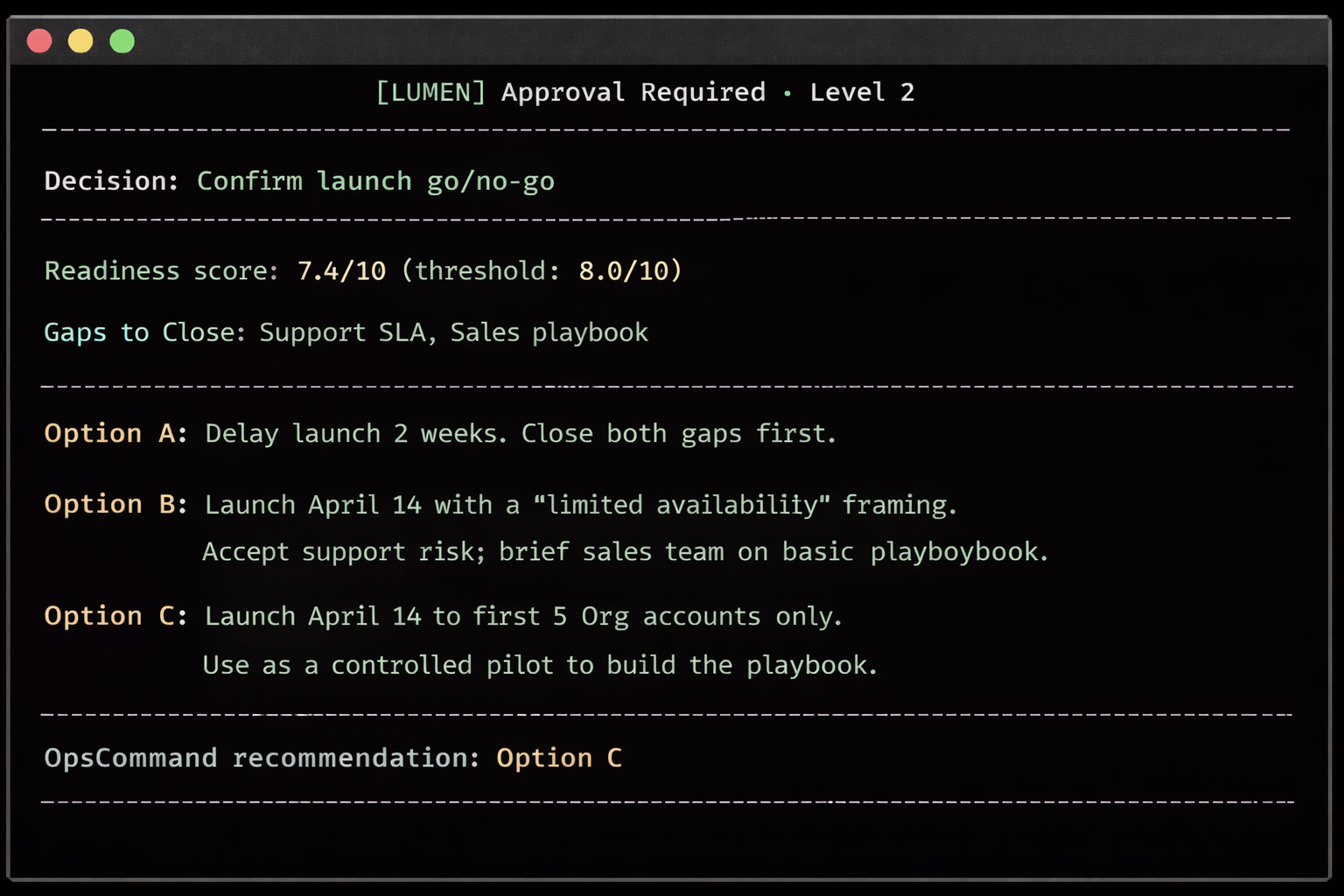
> MODIFY: Proceed with Option C. Define pilot as max 3 accounts (not 5)
to give the sales team a manageable load. Escalation path to
founder for any enterprise issue in the first 30 days.
Reading the W5 Report
Readiness Scorecard — The dimension scores are the most actionable part of the report. Each gap has a specific recommendation. Do not accept a score below the threshold for your launch type without either closing the gap or explicitly acknowledging the risk in your go/no-go decision.
Narrative Suite — The messaging for each audience is ready to use. The claim constraint flags are critical — they identify claims that require legal review before publishing. Do not put a SOC 2 or GDPR claim in public marketing copy without your legal team checking the precise wording.
Pricing Confirmation — PriceLogic always runs an existing customer protection check. If the Org plan pricing creates any risk of retroactive billing changes to Team plan customers, it will flag it. This is the single most important compliance check for pricing changes.
Launch Execution Plan — OpsCommand produces a Day 1/7/30 plan with:
- Day 1: Specific go-live checklist, crisis communications path, escalation contacts
- Day 7: First metrics review (activation rate, first value event, support ticket volume)
- Day 30: PMF impact check (does SignalMonitor show Org plan PMF score movement)
Post-Launch Monitoring Plan — LaunchPad closes the workflow with a monitoring plan. It specifies the exact PostHog events to watch, the thresholds that trigger escalation, and when to declare launch success.
Common Mistakes
Launching below the readiness threshold without explicitly recording the risk. If you choose to launch below threshold (Option B or C in the gate example), the decision memo needs to capture the specific risks and the mitigation. Do not just override and move on.
Not reviewing claim constraint flags. NarrativeEngine flags claims that require legal review. These flags are easy to miss in a long report. Check the claim_constraint_flags section before any copy goes to a designer or a marketing channel.
Skipping the existing customer protection check. PriceLogic runs this automatically. But if you are changing pricing or packaging, read the output carefully. Enterprise customers sometimes have contract clauses that freeze pricing. Violating those clauses is expensive.
Treating the Day 30 check as optional. The post-launch monitoring plan is not complete until you do the Day 30 review. Run /lumen:status at Day 7 and Day 30 and provide the launch outcome tracking ID. Lumen will compare PMF signals against the pre-launch baseline.