Chapter 7: Lumen W1: PMF Discovery
Command: /lumen:pmf-discovery Best for: Founders and PMs validating product-market fit across user segments. PostHog: Required for PMF scoring. Runs in PARTIAL mode without it.
W1 runs a full product-market fit diagnostic. It checks behavioral signals, synthesizes customer interview data, maps the competitive landscape, and produces a prioritized recovery roadmap for weak segments.
By the end of W1, you know: which segments have PMF, which don't, what the most important opportunities are, and what experiments to run first.
When to Run It
Run W1 when you need to answer any of these questions:
- Do we have PMF, and in which segments?
- Our growth has stalled — is this a PMF problem or an execution problem?
- We are about to raise a round — what does the PMF evidence actually look like?
- A segment we were betting on is showing weak retention — what do we do?
Run it quarterly at a minimum. Signal changes. A CONFIRMED PMF score from six months ago may have drifted. Re-running W1 catches this before a board meeting does.
What You Need Before Starting
Required:
- Your segment definitions (e.g., "Solo plan, Team plan, Org plan")
- PostHog connected for PMF scoring (without it, W1 runs in PARTIAL mode — see below)
Strongly recommended:
- At least 10 customer interview transcripts (more is better; 20+ per segment for HIGH evidence)
- 90 days of PostHog event data
Optional but valuable:
- HubSpot connected (adds CRM churn signals to SignalMonitor)
- Supabase connected (persists results to Knowledge Graph with outcome tracking)
Sample Prompt
/lumen:pmf-discovery
Product: Helix — AI-native PM platform for B2B SaaS teams
Segments: Solo plan (free, individual PMs), Team plan ($49/seat, product teams),
          Org plan (enterprise, company-wide rollout)
Stage: 2,400 MAU, 18 months since launch, PLG motion
PostHog: connected (90-day cohort)
Key question: Team plan retention dropped from 72% to 61% D30 over the last two months.
Is this a PMF signal or a product quality issue in a specific use case?
The Agent Sequence
SetupGuide → validates MCPs, seeds business_model_type
EventIQ → validates event schema, confirms GDPR flags
SignalMonitor → scores PMF by segment (SKIPPED without PostHog → PARTIAL mode)
DiscoveryOS → opportunity tree from interviews + PMF signals
MarketIQ → competitive moat map, PMF failure classification
DecideWell → recovery path decision [Level 2 gate]
RoadMap → 0–90 day recovery roadmap
HypothesisLab → 2–3 experiments with power calculations
Orchestrator → final report
Terminal Output Walkthrough
[LUMEN] EventIQ · Validating event schema...
✓ 23 events validated
✓ Business model: B2B SaaS · Cohort method: 30-day retention by first_event
⚠ compliance_flags: [GDPR] — 34% EU user base detected
⚠ Missing event: team_member_invite_accepted — recommend adding to schema
[LUMEN] SignalMonitor · Scoring PMF by segment...
✓ PostHog: 90-day cohort · Last updated: 2026-03-10
Solo plan (free): 28/100 — WEAK [Evidence: MEDIUM]
Team plan ($49/seat): 54/100 — CONFIRMED [Evidence: HIGH]
Org plan (enterprise): 43/100 — CONFIRMED [Evidence: MEDIUM]
⚠ Team plan D30 retention: 61% (down from 72%, -11pp over 8 weeks)
⚠ churn_attribution_type: product — usage dropoff precedes cancellation
Primary signal: roadmap_update events dropped 38% in the affected cohort
[LUMEN] DiscoveryOS · Building opportunity solution tree...
✓ Synthesizing 14 interview transcripts
⚠ Saturation not reached (threshold: 20) — evidence will be MEDIUM
✓ Opportunity tree generated
[LUMEN] MarketIQ · Mapping competitive landscape...
✓ 6 competitors assessed (Linear, Productboard, Notion, Jira, Aha!, Height)
✓ Moat: Switching costs HIGH · Data advantage MEDIUM · Network effects LOW
[LUMEN] DecideWell · Recovery path decision...
[GATE: Level 2 — see gate prompt below]
At the gate:
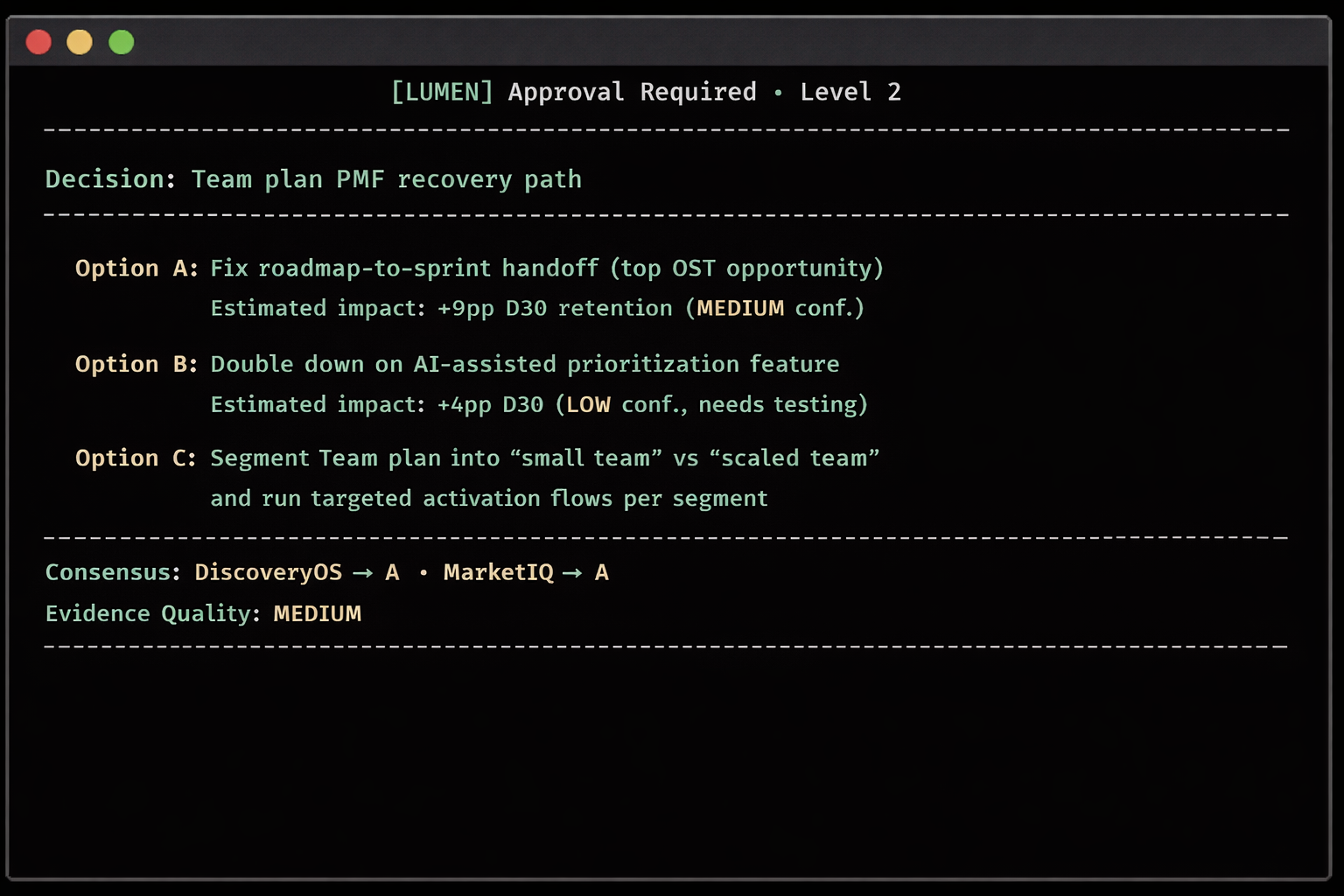
> APPROVE
After approval:
[LUMEN] RoadMap · Building 0–90 day recovery roadmap...
✓ Committed (0–30 days): Roadmap-to-sprint handoff fix
✓ Likely (31–60 days): Activation flow redesign for new Team plan signups
✓ Exploratory (61–90 days): AI prioritization beta test
[LUMEN] HypothesisLab · Designing experiments...
✓ Experiment 1: Roadmap-to-sprint handoff redesign
Hypothesis: Reducing handoff friction will improve D30 retention
Success metric: D30 retention ≥ 68% (up from 61%)
Sample size: n=480 Team plan users · Run time: 4 weeks
MDE: 7pp improvement · Power: 80%
✓ Experiment 2: Onboarding email sequence for new Team plan users
Hypothesis: Sending a triggered "first roadmap" email at Day 3 will
improve activation rate
Success metric: First roadmap_update event within 7 days ≥ 45%
Sample size: n=300 new signups · Run time: 6 weeks
[LUMEN] Orchestrator · Generating W1 PMF Discovery Report...
Reading the W1 Report
The W1 report has five sections. Here is what matters in each.
PMF Scores by Segment — Read the score and the status (CONFIRMED / WEAK). Then read the breakdown: which behavioral signals drove the score. The signal breakdown tells you what "PMF" means for your specific product in that segment, not just a number.
Opportunity Solution Tree — The ranked list of opportunities. Each one has a frequency (how many interview participants cited it) and a behavioral signal (whether PostHog data corroborates it). Focus on the top two opportunities — they usually explain 70% of the PMF gap.
Competitive Context — The competitive moat map from MarketIQ. It assesses switching costs, network effects, data advantages, and brand. A HIGH switching cost score is meaningful for retention strategy. A LOW network effects score is a warning if you are pricing for expansion.
Decision Memo — The recovery path recommendation. This is the section to share with leadership. It includes the options considered, the evidence behind the recommendation, and the outcome tracking ID.
Experiment Briefs — Take these directly to your engineering partner. The power calculations are already done. The sample size and run time estimates are realistic. Do not redesign them unless you have a specific constraint.
PARTIAL Mode: Running Without PostHog
If PostHog is not connected, W1 runs in PARTIAL mode. SignalMonitor is skipped and the PMF Scoring section is empty.
[LUMEN] SignalMonitor · SKIPPED — PostHog not connected
W1 is running in PARTIAL mode. PMF Scoring is unavailable.
EventIQ and DiscoveryOS will run with available data.
To complete PMF scoring: connect PostHog via /lumen:setup and re-run W1.
PARTIAL mode is not failure. You still get:
- A validated event schema from EventIQ
- An opportunity tree from DiscoveryOS (based on interview data you provide)
- A competitive assessment from MarketIQ
- A decision memo from DecideWell (based on qualitative signals only)
The whole report is marked PARTIAL at the top. The PMF Scoring section is blank. Everything else runs normally.
Do not use CSV uploads as a substitute for PostHog. DiscoveryOS and MarketIQ accept interview transcripts and manual context, not raw event CSVs.
Common Mistakes
Giving vague segment definitions. "Small and large users" is not a segment definition. "Team plan users with 3–10 seats in the product-led growth motion" is. Vague segments produce vague PMF scores.
Running W1 without interview data. You can run W1 without interviews — DiscoveryOS will produce an output. But it will be LOW evidence. Before you run W1 with the expectation of HIGH or MEDIUM quality, have at least 10 customer interview transcripts available.
Acting on a PARTIAL mode report as if it were complete. A PARTIAL mode report is a draft. The PMF scores are absent. Base decisions on the qualitative findings, but label them as such.
Not scheduling the outcome review. W1 generates an outcome tracking ID. If you do not re-run SignalMonitor in 30 days, you have no idea whether the recommended experiments worked. The outcome tracking ID is the contract between this run and the next one.