Chapter 8 — Lumen W2: PMF Recovery / Churn Crisis
Command: /lumen:pmf-recovery Best for: Founders and product leaders responding to a PMF regression or sudden churn spike. PostHog: Not required. Behavioural forensics still runs, but the evidence quality is lower without it.
What This Workflow Does
W2 is a crisis response workflow. It diagnoses the cause of a churn spike or PMF regression, classifies the churn type, designs the fastest possible intervention, and produces a leadership briefing with 30/60/90-day recovery tracking.
The keyword is "fastest." W2 is not the workflow for a thoughtful quarterly strategy. It is the workflow you run when something has broken, and you need to act this week.
When to Run It
Run W2 when any of these conditions are true:
- MoM churn has increased by more than 10% in any segment
- SignalMonitor returns a crisis_severity_score of 7 or higher in a W1 run
- NRR drops below 90%
- A single large account churns, and you do not understand why
- Activation has dropped sharply in a segment that previously had PMF
If W1 fires a crisis severity alert, it routes automatically to W2. You can also trigger W2 manually at any time.
What You Need Before Starting
Required:
- A clear description of the symptom (what changed, when, in which segment)
- Any cancellation data or exit interview notes you have already collected
Strongly recommended:
- PostHog connected (behavioural forensics)
- Stripe connected (billing-based churn data)
- HubSpot connected (CRM-based exit signals)
Optional:
- Sentry connected (OpsCommand uses error rate data to distinguish product quality churn from other types)
Sample Prompt
/lumen:pmf-recovery
Product: Helix — B2B SaaS PM platform
Segment: Team plan ($49/seat)
Symptom: MoM churn jumped from 3.1% to 7.4% over 6 weeks.
         We saw a spike starting around the same time we rolled out the new
         roadmap editor (March 1 release).
Data available: PostHog behavioural cohorts, Stripe cancellations,
                3 exit interview notes from HubSpot tickets.
Previous interventions: We sent a 2-email re-engagement sequence in week 4.
                        No measurable impact.
Key question: Is this churn from the roadmap editor release, pricing sensitivity, or something else? And who are we about to lose next?
Note: Include previous interventions. DecideWell explicitly excludes already-tried options from its recovery recommendation.
The Agent Sequence
SetupGuide → MCP check + context seed
SignalMonitor → crisis severity, churn_attribution_type, ARR at risk
EventIQ → [parallel] behavioural forensics, churn cohort fingerprint
DiscoveryOS → emergency exit interviews synthesis
DecideWell → recovery decision [Level 2 gate]
HypothesisLab → fastest-possible intervention (2-week max experiment)
GrowthIQ → at-risk account ranking, win-back sequence, NRR decomposition
OpsCommand → leadership briefing
Orchestrator → W2 report + 30/60/90-day outcome tracking
Terminal Output Walkthrough
[LUMEN] SignalMonitor · Confirming crisis signals...
✓ PostHog: 90-day cohort
crisis_severity_score: 8.1/10 — CRISIS (threshold: 7.0)
ARR at risk: ~$142,000 (estimated from Stripe cancellation trajectory)
churn_attribution_type: PRODUCT
Primary signal: roadmap_update events dropped 61% in churned cohort
7 days before cancellation — no pricing page visits
Timeline: drop correlates with roadmap editor release (2026-03-01)
[LUMEN] EventIQ · [parallel] Behavioural forensics...
✓ churn_cohort_fingerprint: 2026-03 Team plan, roadmap editor users
Affected cohort: users who used roadmap editor ≥2x before the release,
then stopped after the update
Feature adoption: new roadmap editor adopted by only 38% of Team plan users
(benchmark for new features: 65% at 3 weeks)
[LUMEN] DiscoveryOS · Emergency exit interview synthesis...
✓ 3 exit interview notes analysed (saturation NOT reached — evidence: LOW)
⚠ Recommend: 5 additional exit interviews within 72 hours for MEDIUM evidence
Top themes from available interviews:
1. "The new roadmap editor broke my existing templates" (2/3 participants)
2. "I can't undo changes anymore — I lost a week of work" (2/3 participants)
3. "Pricing wasn't the issue — the product regressed" (3/3 participants)
[LUMEN] GrowthIQ · NRR decomposition + at-risk account ranking...
✓ Stripe + HubSpot connected
NRR decomposition (current month):
Starting MRR: $48,200
Expansion: +$1,840 (+3.8%)
Contraction: -$2,100 (-4.4%)
Churn: -$4,920 (-10.2%)
Net MRR: $43,020
NRR: 89.2% (below 90% threshold)
At-risk accounts (ARR × renewal proximity):
1. Synthex Labs $28,400/yr · renews in 12 days · health score 3.2/10
2. Orbit Design Co. $14,200/yr · renews in 23 days · health score 4.1/10
3. Flux Analytics $9,800/yr · renews in 31 days · health score 4.8/10
At the Level 2 gate:
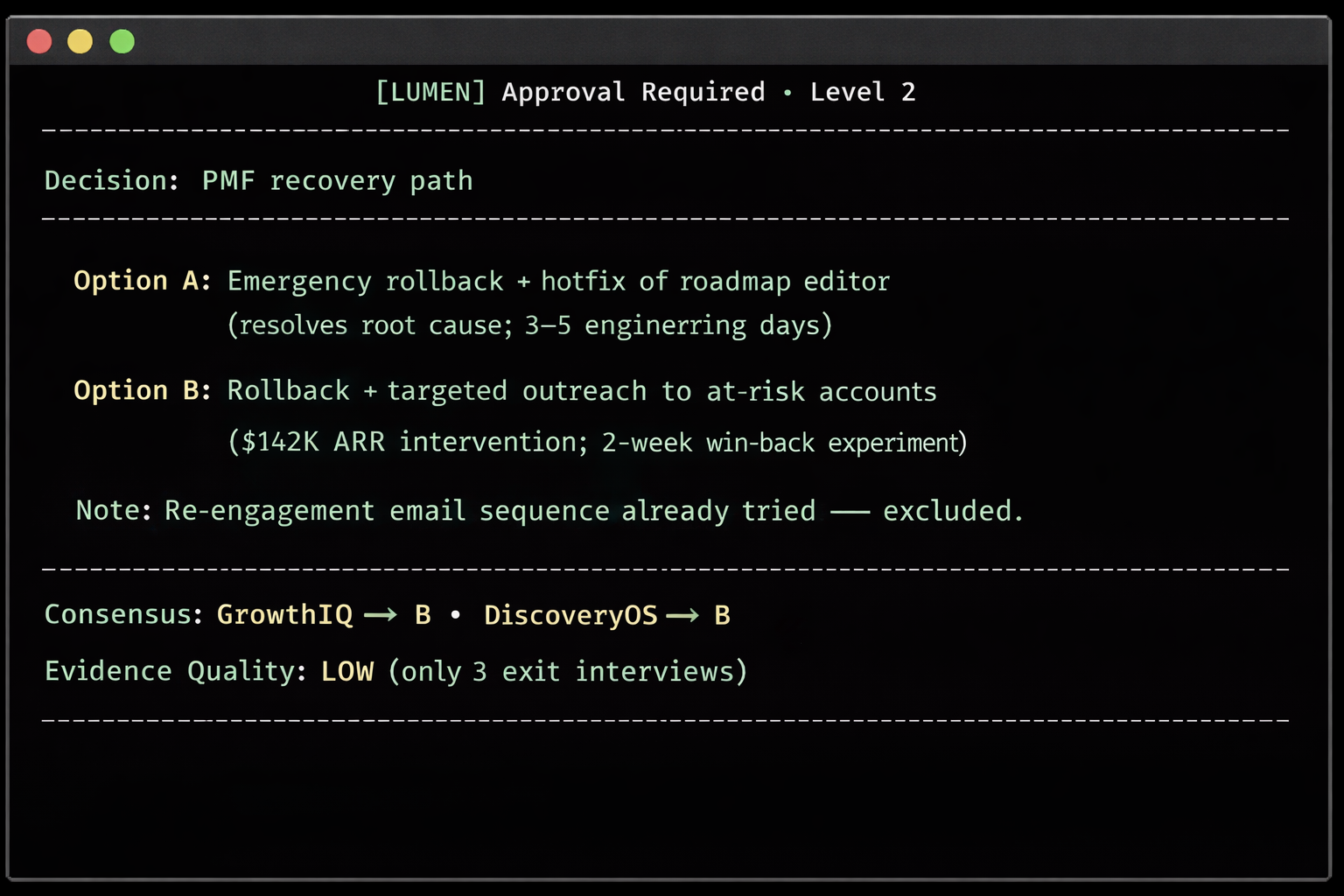
> MODIFY: Prioritize rollback for Synthex Labs (renewal in 12 days) first.
Then run the experiment for the broader cohort.
Reading the W2 Report
Crisis Summary — Severity score, ARR at risk, and churn classification. Share this section with your CEO first if it is the first time they are hearing about the crisis.
Churn Attribution — The classification is important. Product churn (usage dropoff before cancellation), pricing churn (spike coincides with price change), competitive churn (exit interviews cite a specific competitor), or involuntary churn (payment failure). The recovery path is completely different for each type. Misclassifying churn leads to the wrong intervention.
At-Risk Account List — Ranked by ARR × renewal proximity × health score. This is the list your CSM should have open right now. The highest-ranked accounts need a personal call, not an automated email.
Experiment Brief — W2 designs a 2-week maximum experiment. This is intentional — in a crisis, a 6-week experiment is not useful. The brief specifies the fastest measurable intervention and what constitutes evidence of recovery.
Leadership Briefing — OpsCommand generates an update calibrated to the awareness level of your leadership. If this is the first briefing, it includes context. If it is a follow-on (Supabase connected, prior W2 run exists), it leads with a delta from the previous report.
30/60/90-Day Tracking IDs — The most important section to note. The outcome tracking IDs are how you close the loop. Re-run /lumen:churn at Day 14 and Day 30 and provide these IDs. Lumen will compare against the baseline established in this run.
The 72-Hour Rule
W2 is designed around urgency. DiscoveryOS recommends conducting exit interviews within 72 hours of detecting a crisis. After 72 hours, memory fades and churned customers move on. If you do not have recent exit interviews when you run W2, plan to get them within the next three days before running W2 again with the new data.
Common Mistakes
Running W2 without specifying what has already been tried. DecideWell explicitly excludes interventions you have already attempted. If you do not tell it what you have already done, you may get a recommendation for an email campaign you just ran.
Using only behavioral data without exit interviews. SignalMonitor classifies churn attribution from behavioral signals. But behavioral signals alone can produce false positives. Product churn and competitive churn look identical until someone tells you they left because of a competitor. Run at least three exit interviews before trusting the churn attribution type.
Not acting on the at-risk account list within 24 hours. The at-risk list is sorted by urgency. The top account on the list has a renewal in days. Every day you wait is a day closer to an avoidable churn event.
Waiting for HIGH evidence before acting. In a crisis, you will rarely have HIGH evidence. Act on the MEDIUM or LOW evidence Lumen provides, but be explicit about the uncertainty in your leadership briefing.