Chapter 9: Lumen W3: Quarterly Strategy
Command: /lumen:strategy
Best for: CPOs and product leaders planning a quarter or preparing a strategy review. PostHog: Not required. Recommended for PMF signal quality.
W3 runs a full quarterly strategy cycle. It synthesizes current PMF signals and competitive positioning, defines or revises the North Star metric, cascades OKRs across teams, builds a prioritized roadmap, models pricing, and produces a narrative suite for leadership and external audiences.
A complete W3 run produces everything a product leader needs for a quarterly business review before you have written a single slide.
When to Run It
Run W3 at the start of every quarter. Also run it when:
- Your North Star metric is under debate, and the team lacks alignment
- A significant external change (competitor move, market shift, fundraise) requires a strategy reset
- You are scaling from one segment to two and need to re-prioritize
- Engineering capacity changed significantly (team grew, lost key people, or a major incident consumed a sprint)
What You Need Before Starting
Required:
- Current PMF status by segment (run W1 first if you do not have a recent PMF score)
- Engineering capacity for the quarter (number of engineers, sprint velocity, known commitments)
Strongly recommended:
- Prior quarter interview synthesis (what you learned from customers last quarter)
- Competitive landscape notes (recent competitor moves, new entrants)
- Any board-level OKR constraints (goals the board has already signed off on)
Optional but impactful:
- Stripe connected (pricing model analysis is stronger with real billing data)
- HubSpot connected (GrowthIQ needs CRM data for expansion and contraction analysis)
- PostHog connected (SignalMonitor contributes PMF signals to the strategy foundation)
Sample Prompt
/lumen:strategy
Product: Helix — AI-native PM platform, B2B SaaS
Quarter: Q3 2026 (April 1 – June 30)
Current state:
  - MAU: 2,400 (Team plan 68%, Org plan 12%, Solo plan 20%)
  - NRR: 94% (recovering from Q2 churn event)
  - PMF: Team plan 58/100 · Org plan 43/100 · Solo plan 29/100
  - North Star: Monthly Active Users (currently)
  - Team capacity: 6 engineers, 2 sprints/month, 8-week committed backlog
  - Known commitments: SOC 2 Type I audit (due May 15), 3 customer contract clauses
Q3 goals:
  - Raise Team plan NRR to ≥105%
  - Get Org plan PMF to 55+/100
  - Evaluate whether to build a developer API
Constraints:
  - Cannot deprioritize SOC 2 work
  - No pricing changes to existing customers before July 1
  - Board has approved a $2M ARR target for the end of Q3
Prior quarter learnings:
  - Roadmap-to-sprint handoff was the top pain in Team plan interviews
  - Org plan champions want Slack + Jira integration before enterprise rollout
  - Solo plan users are churning to free Notion templates
The Agent Sequence
SetupGuide → MCP check + context seed
SignalMonitor → [parallel] PMF signals, evidence_quality
MarketIQ → [parallel] competitive moat map, positioning
DiscoveryOS → prior quarter interview synthesis, opportunity tree
NorthStar → North Star confirmation/revision, OKR cascade [Level 2 if NS changes]
DecideWell → three strategic alternatives [Level 1]
PriceLogic → pricing model aligned to sales_motion
RoadMap → quarterly roadmap (committed/likely/exploratory)
NarrativeEngine → [parallel] narrative suite for each audience
OpsCommand → [parallel] operating rhythm, executive update
Orchestrator → W3 Strategy Report
Terminal Output Walkthrough
[LUMEN] SignalMonitor + MarketIQ running in parallel...
SignalMonitor:
✓ Team plan: 58/100 PMF CONFIRMED · D30 retention recovering (65%, up from 61%)
✓ Org plan: 43/100 PMF CONFIRMED (borderline)
✓ churn_cohort_fingerprint: roadmap editor regression cohort stabilizing
MarketIQ:
✓ Competitive assessment complete
Primary threat: Linear (Team plan) — shipping AI features rapidly
Opportunity: Productboard users are dissatisfied with pricing ($99/seat);
3 Helix support tickets from Productboard refugees in Q2
Moat: Switching costs HIGH (workflow integration depth)
Network effects LOW (single-player use cases dominate)
Data advantage MEDIUM (growing with KG if Supabase connected)
[LUMEN] NorthStar · Defining North Star metric...
Proposed revision: "Weekly Active Teams" (teams with ≥3 members completing
≥1 roadmap update in 7 days)
Replaces: "Monthly Active Users"
Rationale: MAU does not distinguish high-value team workflows from solo use.
Weekly Active Teams correlates with NRR at r=0.82 and
seat expansion at r=0.79 across 6 quarters of data.
[GATE: Level 2 — North Star change requires PM approval]
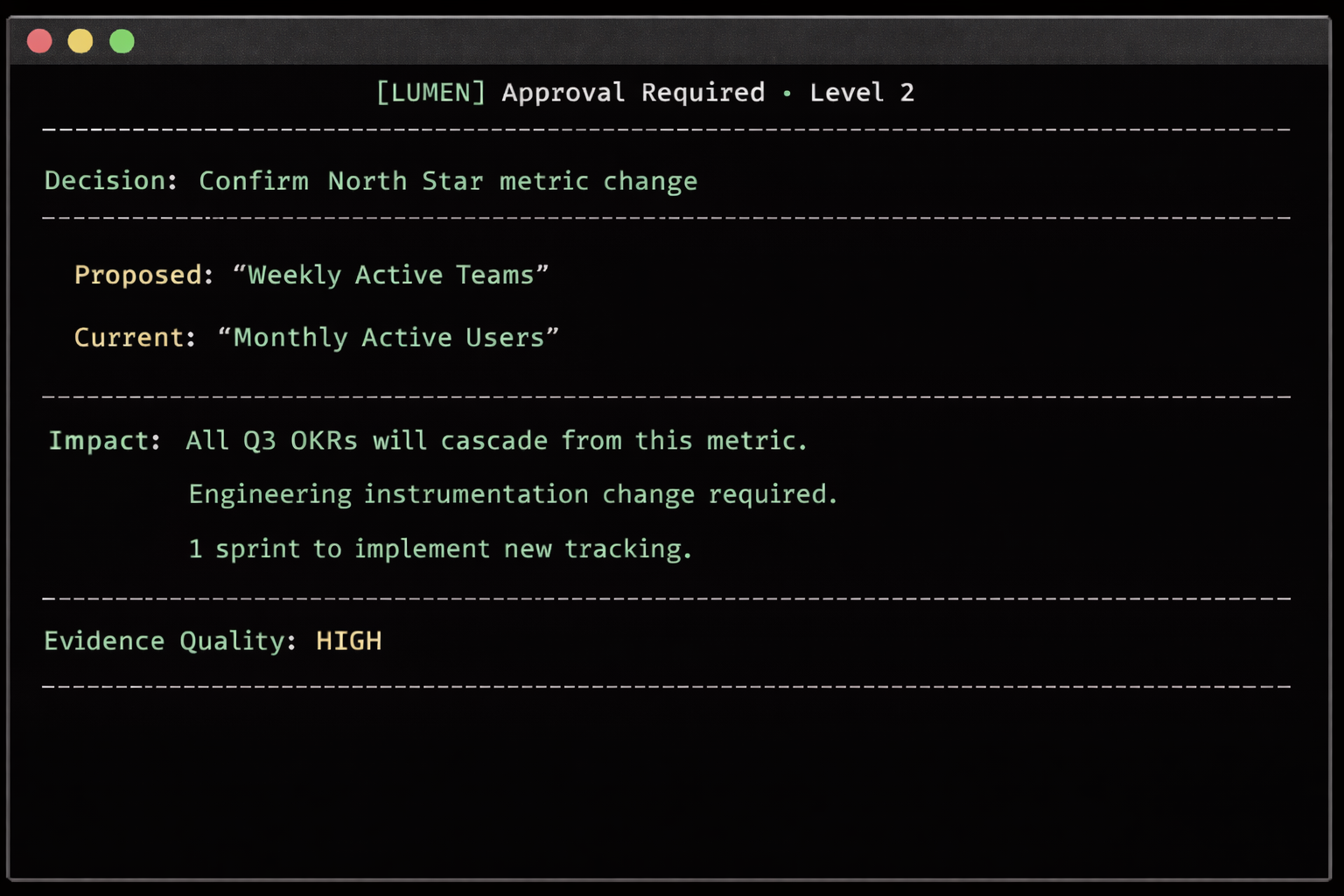
> APPROVE
[LUMEN] NorthStar · OKR cascade...
✓ North Star: Weekly Active Teams · Target: 280 by June 30 (from 190 today)
Team 1 — Product:
O: Increase Team plan activation and habit formation
KR1: D7 activation rate ≥ 52% (from 41%)
KR2: Weekly Active Teams ≥ 280
KR3: Roadmap-to-sprint handoff p50 < 2 business days
Team 2 — Growth:
O: Expand Org plan footprint
KR1: Org plan NRR ≥ 108%
KR2: 4 new Org plan accounts closed (Slack/Jira integration required for 3)
KR3: Org plan PMF score ≥ 55/100 by June 30
Conflict detected: Team 1 KR3 and Team 2 KR2 share the sprint-planning
feature track — capacity may be insufficient. Routing to DecideWell.
[LUMEN] PriceLogic · Pricing assessment...
✓ Analysis complete
Current Team plan pricing: $49/seat/month — 11% below market (benchmark: $55)
Recommendation: No price increase before July 1 per intake constraint.
Opportunity: Introduce usage-based add-on for AI features (Q4 consideration)
[LUMEN] RoadMap · Quarterly roadmap...
✓ Capacity: 6 engineers × 2 sprints × 10 weeks = 120 sprint-points available
Known commitments: SOC 2 (28 points) + customer contracts (14 points) = 42 points reserved
Available for product work: 78 points
Committed track (78 points):
- Roadmap-to-sprint handoff redesign (24 points · Weeks 1–4)
- Slack + Jira integration for Org plan (32 points · Weeks 2–8)
- Weekly Active Teams instrumentation (8 points · Week 1)
- SOC 2 + customer commitments (14 points reserved)
Likely track (conditional on sprint velocity):
- AI-assisted prioritization beta (22 points · Weeks 6–10)
Exploratory track (not committed):
- Developer API investigation spike (4 points if capacity permits)
Reading the W3 Report
North Star and OKRs — Share this section with your engineering leads and team leads before anything else. The OKR cascade is designed for team-level planning. Each OKR has a metric formula and a target. The conflict flags (if any) are explicitly surfaced — do not ignore them.
Roadmap — The committed/likely/exploratory structure is deliberate. Committed work is what you are shipping. Likely work is what you will ship if velocity holds. Exploratory work is what you are considering but have not scoped. Never communicate exploratory items to customers as roadmap commitments.
Pricing Model — Level 1 advisory. You can override within 24 hours. If PriceLogic recommends a price change and you are not ready to act on it, note the recommendation and revisit next quarter. Do not dismiss it without recording why.
Narrative Suite — NarrativeEngine writes the strategy narrative in three voices: executive (board and investors), team (internal alignment), and market (sales and marketing). Each section is ready to use with light editing. The executive version is calibrated to the outcome tracking context — if Supabase is connected and this is not the first W3 run, it leads with delta from last quarter.
Operating Rhythm Calendar — OpsCommand produces a standing cadence recommendation: weekly team syncs, monthly strategy reviews, quarterly board prep timing. This is advisory. Adopt what fits your stage.
Common Mistakes
Running W3 without W1 data. Strategy without PMF signals is opinion. Run W1 before W3. If you already have a recent W1 output, reference it in your prompt. Lumen will not re-run the full PMF workflow — it will use the context you provide.
Giving vague capacity numbers. "We have a few engineers" does not produce a useful roadmap. Give the actual numbers: engineers, sprint velocity, and known non-product commitments (compliance work, customer contracts, tech debt).
Skipping the conflict flags. The OKR cascade often surfaces cross-team conflicts that are real and difficult. Lumen routes these to DecideWell for structured resolution. Do not skip the gate just because the conflict is uncomfortable.
Not sharing the narrative suite. NarrativeEngine produces usable draft copy. It is not a final artefact — you will edit it. But do not throw it away. Even a first draft from NarrativeEngine saves hours of blank-page time.